How to Edit A Facebook Post
Tuesday, April 24, 2018
Edit
One of the missing out on functions on Facebook was the capability to How To Edit A Facebook Post.

While websites like Google Plus have had the ability to edit posts when they first launched, Facebook is finally rolling out the ability to modify posts to pages and profiles.
The BBC reported concerns over the abuse of Facebook modified posts. While some individuals might see editing posts as an issue, I consider this excellent news.
This is since you can now go and fix any spelling or grammar errors in your posts!
To modify Facebook posts on your Facebook Page or Profile, follow these guidelines.
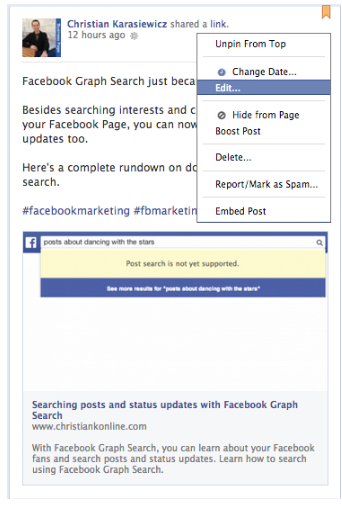
1. Go to a post on your Facebook Page or Facebook Profile
2. Click the dropdown menu in the upper-right corner
3. Select Edit ...
4. Select Done modifying
Typical questions on modifying Facebook posts
What kinds of posts can I modify on Facebook?
Yes. You can modify posts on a Facebook Page, Facebook Profile and even in a Facebook Group.
Can I modify Facebook posts in the news feed?
No. You can not edit Facebook posts in the news feed. You have to go directly to the post on a Facebook Page, Facebook Profile or in a Facebook Group.
Can I modify Facebook posts on a mobile phone?
Yes. You can edit Facebook posts from a mobile phone.
Does Facebook keep a history of my post modifies?
Yes. When you modify Facebook posts, Facebook keeps a record. Your fans, pals, and group members can return and see your edit history on your post.
Does this mean I can now modify Facebook posts in the activity log?
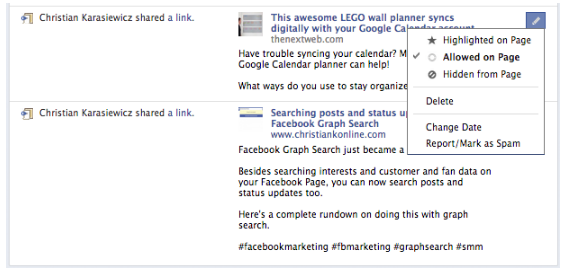
No. Sadly, the only way to edit posts in the activity log is to delete and schedule them again.
Wrap-up on editing posts
While you can return and edit Facebook posts, be sure you are editing them for the best reasons and not to deceive fans.
Keep in mind, any edits you make are stored in the edit history and can be seen.
Do you have other questions about editing posts on Facebook? Let me in the remarks below.
Now you can manage who can talk about your public posts in Facebook. The social network simply added a new facility that lets you filter who can talk about your post. Formerly, you have to enable 'Followers' in order to get the alternative, now you can manage this on your all public posts no matter whether you have actually turned on or off fans include. It appears the new tweak is offered just to select users.
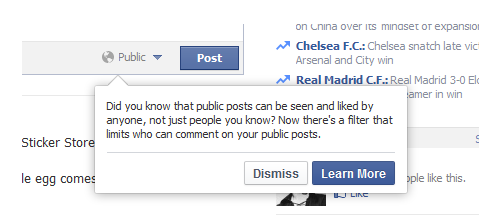
Today, when I visited to Facebook, a brand-new pop-up appeared near to status author which reads, "Did you know that public posts can be seen and liked by anybody, not simply individuals you know? Now there's a filter that restricts who can discuss your public posts". The 'Find out more' button browsed me to the Facebook assistance page which offers the response to "Who can like or comment on things I post?". Inning accordance with the aid page, some users can now adjust who can comment on their post, brand-new option will be readily available in "Account Settings", users can turn on or off the filter under "Public Posts" menu.
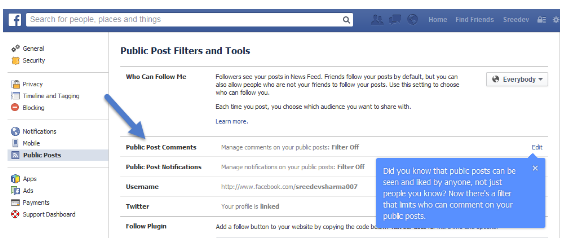
In the "Account Settings", there is likewise some modifications, the "Followers" alternative in the left menu has become "Public Posts". This is where users can manage public post comment filter. Users can turn on or off the filter from "Public Post Remarks" sub-menu.
If you choose Filter Off, then anyone can talk about your public posts and if you select Filter On, it will limit the audience.

When you publish something while keeping the Filter On, then the 'Remark' button won't be active to your followers or people other than your friends. It also informs, the author of the status limiting who can talk about the post.
Previously the 'Fan Remarks' option only offered to users who have actually turned on the followers. Way, if you shut off fans, 'Who can discuss your public posts?' alternative will become unnoticeable. But, now things altered, through this brand-new settings you can control your public posts even if you have turned off followers.
The new function no yet rolled-out to all users.
Nevertheless, it will be a convenient tool for privacy concerned people, where they can publish things openly with limiting comments from unknowns.
While websites like Google Plus have had the ability to edit posts when they first launched, Facebook is finally rolling out the ability to modify posts to pages and profiles.
The BBC reported concerns over the abuse of Facebook modified posts. While some individuals might see editing posts as an issue, I consider this excellent news.
This is since you can now go and fix any spelling or grammar errors in your posts!
To modify Facebook posts on your Facebook Page or Profile, follow these guidelines.
How To Edit A Facebook Post
1. Go to a post on your Facebook Page or Facebook Profile
2. Click the dropdown menu in the upper-right corner
3. Select Edit ...
4. Select Done modifying
Typical questions on modifying Facebook posts
What kinds of posts can I modify on Facebook?
Yes. You can modify posts on a Facebook Page, Facebook Profile and even in a Facebook Group.
Can I modify Facebook posts in the news feed?
No. You can not edit Facebook posts in the news feed. You have to go directly to the post on a Facebook Page, Facebook Profile or in a Facebook Group.
Can I modify Facebook posts on a mobile phone?
Yes. You can edit Facebook posts from a mobile phone.
Does Facebook keep a history of my post modifies?
Yes. When you modify Facebook posts, Facebook keeps a record. Your fans, pals, and group members can return and see your edit history on your post.
Does this mean I can now modify Facebook posts in the activity log?
No. Sadly, the only way to edit posts in the activity log is to delete and schedule them again.
Wrap-up on editing posts
While you can return and edit Facebook posts, be sure you are editing them for the best reasons and not to deceive fans.
Keep in mind, any edits you make are stored in the edit history and can be seen.
Do you have other questions about editing posts on Facebook? Let me in the remarks below.
Facebook Brings New Filter To Public Posts; Now You Have More Control On Things You Post Publicly
Now you can manage who can talk about your public posts in Facebook. The social network simply added a new facility that lets you filter who can talk about your post. Formerly, you have to enable 'Followers' in order to get the alternative, now you can manage this on your all public posts no matter whether you have actually turned on or off fans include. It appears the new tweak is offered just to select users.
Today, when I visited to Facebook, a brand-new pop-up appeared near to status author which reads, "Did you know that public posts can be seen and liked by anybody, not simply individuals you know? Now there's a filter that restricts who can discuss your public posts". The 'Find out more' button browsed me to the Facebook assistance page which offers the response to "Who can like or comment on things I post?". Inning accordance with the aid page, some users can now adjust who can comment on their post, brand-new option will be readily available in "Account Settings", users can turn on or off the filter under "Public Posts" menu.
In the "Account Settings", there is likewise some modifications, the "Followers" alternative in the left menu has become "Public Posts". This is where users can manage public post comment filter. Users can turn on or off the filter from "Public Post Remarks" sub-menu.
If you choose Filter Off, then anyone can talk about your public posts and if you select Filter On, it will limit the audience.
When you publish something while keeping the Filter On, then the 'Remark' button won't be active to your followers or people other than your friends. It also informs, the author of the status limiting who can talk about the post.
Previously the 'Fan Remarks' option only offered to users who have actually turned on the followers. Way, if you shut off fans, 'Who can discuss your public posts?' alternative will become unnoticeable. But, now things altered, through this brand-new settings you can control your public posts even if you have turned off followers.
The new function no yet rolled-out to all users.
Nevertheless, it will be a convenient tool for privacy concerned people, where they can publish things openly with limiting comments from unknowns.